On 13 May, nearly eighty members of the Royal Belgian Forestry Society (SRFB) gathered in Namur for a field visit, held ahead at the Beau Vallon
The location was no accident. A few months earlier, Beau Vallon, a care institution specialising in psychiatry and mental health in Namur, had become the owner of the wood lying behind its buildings. It named the wood the Forest of Beings (la forêt des Êtres), and forest-based care activities are now finding a clearer and better-organised place there, with facilities and a management approach gradually structured around recommendations developed with UNature.
This acquisition was not a given. Put up for sale by the religious community that had founded the Beau Vallon psychiatric hospital, the forest prompted a good deal of internal reflection. The project owes much to the commitment of Jérôme Thonon, a psychologist at Beau Vallon, who has long taken his patients into the forest and trained in nature (re)connection. Convinced of the benefits of these practices, he helped the initiative come to maturity.
It was this forest, now undergoing therapeutic certification, that the participants came to walk.
Before the participants were split into two groups, François Rassart, director of Beau Vallon, officially received the PEFC label (sustainable management) for the Forest of Beings. This is no protocol detail. It is a prerequisite: any forest seeking therapeutic certification must first be able to attest to sustainable silvicultural management. Before it is a place of care, a therapeutic forest remains a well-managed forest.
A visit told in several voices
To make discussion easier, two groups were formed. Each brought together an SRFB guide, a forest manager and a carer. The arrangement was designed to bring into dialogue three perspectives that rarely meet on the same ground.
In the first group, Philippe de Wouters and Amir Bouyahi of the SRFB drew participants into a lively back-and-forth with Dr François-Xavier Polis, a psychiatrist at the Dave Neuropsychiatric Centre (the “Athanor” adolescent unit), and Patrick Vandenbroucke, technical and logistics director at Beau Vallon. Rather than lecture, they chose to draw out the questions, leaving the forester and the therapist free to voice their own.
In the second group, Anne Bolle, who leads the Forest4Youth project at the SRFB, was joined by Sébastien Jandrain, a forest manager appointed by Beau Vallon, and Marie-Christine Werner, a carer at the institution. Her account, deeply rooted in the daily lives of the patients, made a particular impression on those present.
Marie-Christine wasn’t speaking in abstract terms. She described what she observes, week after week. In the forest, the adolescents are quite literally different. More open. More curious. More attentive. The constant need for boundaries, for redirection, for calling them back to order, so prevalent in the hospital, almost fades of its own accord. As if the forest were doing part of the work in her stead.
To illustrate her observation concretely, she shared a scene from the week before the General Assembly. The institution had just taken in two pairs of hedgehogs ahead of their release, and the young people did not merely settle them in the forest: ever since, they have watched over their wellbeing, fed them cat kibble and brought them water. “It is lovely to see them caring for these little animals,” she said, “in a forest that, in turn, cares for them.” The image, in its simplicity, says a great deal. Something has shifted: adolescents usually seen as vulnerable become protectors, with the forest in the background acting as a benevolent third party.
In the first group, Dr François-Xavier Polis rounded out this testimony, describing the short therapeutic stays the Dave Neuropsychiatric Centre organises in private forests. One anecdote struck the audience in particular. At the closing session at the end of a stay, when the young people take the floor, what they speak about, often to the exclusion of all else, is the forest. Not the carers, not the therapies, not the buildings. The forest.
What makes a forest a therapeutic place?
Throughout the walk, the question was on everyone’s lips: what, in concrete terms, sets an ordinary forest apart from one with a therapeutic vocation?
The SRFB answers with a tool now being finalised, the PTFI (Potential Therapeutic Forest Index). Drawing on a review of more than sixty recent scientific publications, it offers a reading grid in several parts:
- general characteristics: PEFC/FSC certification, minimum size, type of management
- ecological criteria: diversity of species, vertical structure, canopy cover, presence of conifers (and their monoterpenes), deadwood, notable features, the birdsong soundscape;
- topography and soil: relief, soil quality, winding paths
- infrastructure: accessibility, amenities, absence of nuisances.
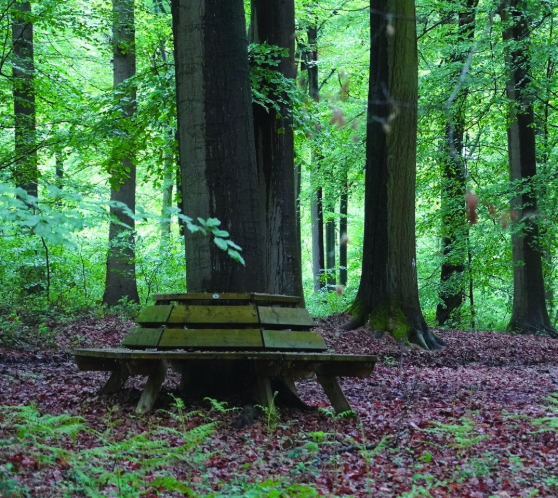
A resting point in the Forest of Beings, now undergoing therapeutic certification.
One point was stressed several times in the field: no criterion, on its own, is disqualifying. The PTFI is not a verdict. It is a tool for dialogue that, faced with each gap, opens up a recommendation and a shared line of work between forester and carer.
A few elements drew particular attention: the winding paths, which invite you to slow down and sustain what the Kaplans, the psychologists, called “soft fascination”; deadwood, a marker of ecological maturity but also a prompt for the imagination; and the soundscape, whose richness is directly linked to the restoration of attention.
Production and care: a choice between the two?
This is probably the most sensitive question for an audience of forest owners, and it was not sidestepped. This forest, now undergoing therapeutic certification, remains a productive forest. The participants also noticed the markings. The revenue generated from forest operations will help, among other things, to fund the facilities related to the site’s therapeutic purpose.
The message conveyed by the SRFB was this: a landowner can give a forest a specific purpose without sacrificing the economic aspect of its management. Beau Vallon does not illustrate an opposition between the two, but a way of bringing them together.
And scepticism is legitimate. It is even healthy in the face of an emerging approach like this one. Behind the questions raised lie concrete concerns: economic viability, management consistency, and the sustainability of land uses. Rather than sidestepping them, the goal is to address them, analyze them, and document them. It is precisely in this spirit that the SRFB joined the European Forest4Youth project: to move from intuition to evidence, from anecdotal accounts to evaluation, and, ultimately, to enable everyone to form an informed opinion.
Testing, Measuring, Sharing
Forest4Youth is an Interreg project bringing together five partner countries. Its aims: to show that complementary therapy (alongside conventional medicine) can benefit adolescents in psychological distress, and to equip carers and foresters to put these forest-based treatments in place.
Three gaps need to be filled to convince the public authorities:
- scientific evidence: two universities (ULB and RCSI3) are supporting the project and will publish their findings;
- a training plan: led in particular by UNature, in health-and-forest pairs;
- validated host sites: this is the work to be done with the PTFI, which will be tested in the field from September 2026 and over eighteen months, through the follow-up of 400 young people across the five partner countries.
At the end of June, a first version of a practical guide to therapeutic forest outings appears, intended jointly for carers and foresters. It will grow richer as feedback from the field comes in.
Beyond the visit
This forest is already, in practice, a therapeutic place: the activities carried out by the carers bear witness to it. The work of the SRFB, with its European partners, is to give these practices a framework, tools and recognition, so that one day what benefits a few today may become accessible to many, wherever the need makes itself felt.
Ultimately, the goal remains simple: that through repeated visits to the forest, a young person comes to hold within them the certainty that, for the rest of their life, whenever they feel the need, they will be able to find renewal there.